
Entryways & Closets Inspirations for Studio Apartments and Compact Homes
- Why the Entryway Is So Important in a Studio Apartment
- Start by Studying the Space You Already Have
- Measure Before You Add Storage
- How to Create an Entryway When Your Studio Apartment Has No Foyer
- Build The Entryway Around What You Actually Use
- The Main Components Of A Functional Small Entryway
- What If Your Apartment Has No Entry Closet
- How To Organize A Small Entryway Closet
- Use The Vertical Space Inside The Closet
- Rotate Your Closet By Season
- Do Not Ignore The Closet Door
- Group Similar Items Together
- Open Closet Or Closed Closet: Which Works Better?
- Studio Apartment Entryway Ideas For Different Space Problems
- The Current Rotation Idea for Shoes and Bags
- How to Make a Small Entryway Feel Separate From the Living Area
- Renter-Friendly Entryway Solutions
- Common Entryway And Closet Mistakes
- A Simple Entryway Planning Exercise
- Create A “One-Surface” Control Point
- Make The System Easy To Maintain
- A Practical Small-Entryway Checklist
- How The Entryway Connects To The Rest Of Your Studio
- Entryway And Closet Inspirations: Choosing The Right Approach For Your Home
-
Frequently Asked Questions About Studio Apartment Entryway Ideas
- How Do I Create An Entryway In A Studio Apartment?
- What If My Studio Apartment Has No Entry Closet?
- How Do I Organize A Small Entryway Closet?
- Is Open Or Closed Storage Better For A Small Entryway?
- How Can I Save Floor Space In A Small Entryway?
- How Can I Make My Small Entryway Look Less Cluttered?
- What Are Good Renter-Friendly Entryway Ideas?
- Should I Keep All My Shoes In The Entryway?
- Does A Studio Apartment Really Need An Entryway?
- Final Thoughts
Walking into a small home should not immediately feel like walking into a storage problem.
But in a studio apartment, the entrance often has to handle several jobs at once.
Shoes need somewhere to go. Keys need to be easy to find. Bags, jackets, packages, umbrellas and everyday belongings can quickly collect near the door.
And because a studio apartment often has very little separation between rooms, anything left around the entrance can become part of the visual experience of the entire home.
That is why a good entryway is not simply about making the entrance look attractive.
It is about creating a small, practical system that makes entering, leaving, storing and moving through your home easier.
This guide explores studio apartment entryway ideas, closet organization, storage solutions, renter-friendly approaches and ways to create a functional entrance even when your apartment has no traditional foyer.
This guide brings together researched small-space organization principles and practical ideas for compact living. It is intended as an educational resource rather than professional architectural or interior-design advice.
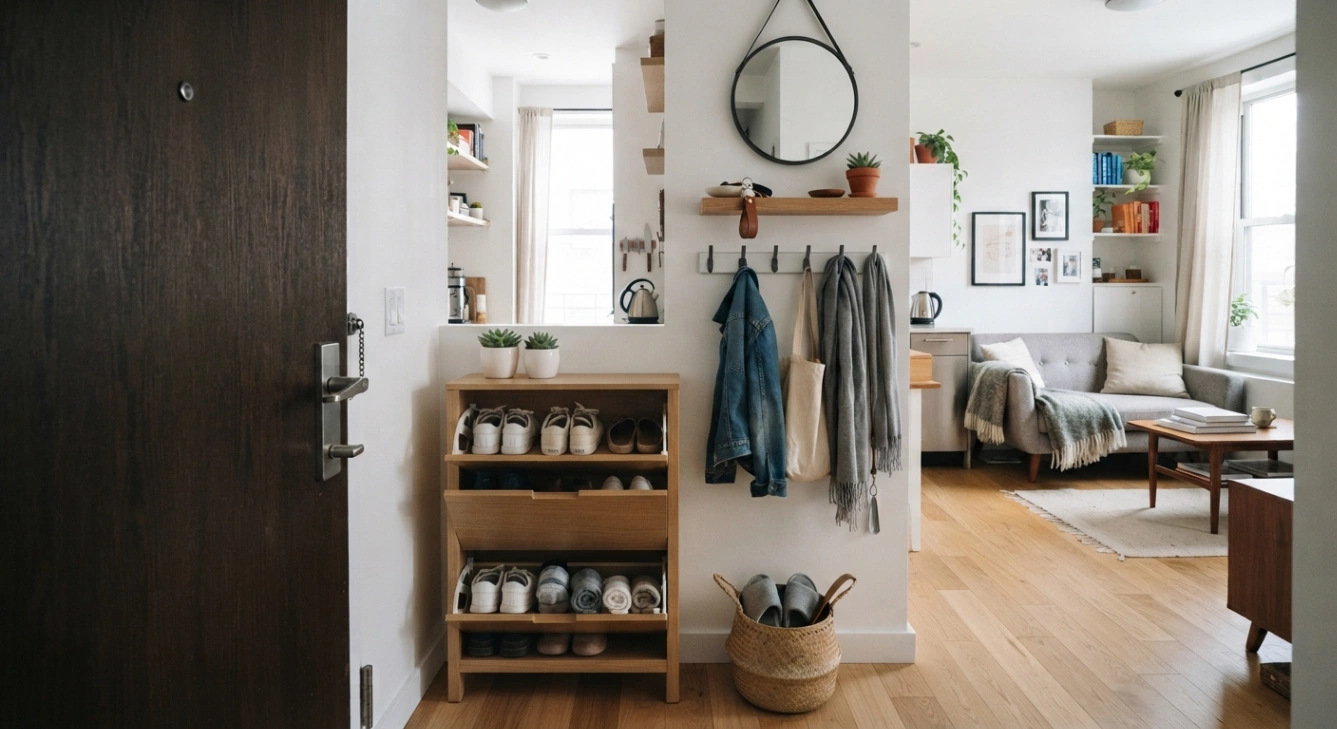
Why the Entryway Is So Important in a Studio Apartment
In a larger home, the entrance may have its own hallway, foyer, mudroom or dedicated closet.
A studio apartment may have none of these.
The front door can open almost directly into the living area, kitchen, sleeping area or a narrow passage.
That means the entrance has to work harder.
Think about what happens during the first few minutes after you arrive home.
You open the door.
You take off your shoes.
You put down your keys.
You remove your jacket or bag.
You may bring in groceries.
You may receive a package.
You may need somewhere to place an umbrella or other everyday item.
If there is no obvious place for these things, they will usually end up wherever there is available space.
That is how a small entrance becomes cluttered.
The solution is not automatically to add more furniture.
A better starting point is to give frequently used items a predictable home.
This is one of the strongest principles behind effective entryway organization: create a landing zone that matches real daily behavior rather than designing only for appearance. Professional organizers similarly emphasize dedicated drop zones, vertical storage, seasonal rotation and keeping high-traffic entrances focused on everyday items.
Your entryway is therefore not simply decoration.
It is a transition system between outside and inside.
Start by Studying the Space You Already Have
Before searching for furniture or storage products, study the entrance itself.
This is one of the most important steps when planning small apartment entryway ideas because the available space is often different from what you initially imagine.
Stand near the front door and look at the area from several directions.
Ask yourself:
Where does the door open?
Does it swing inward or outward?
Where does the natural walking path begin?
What part of the entrance becomes crowded first?
Is there a wall beside the door?
Is there an existing closet?
Is there unused vertical wall space?
Is the entrance beside the kitchen?
Is it close to your bed?
Is there enough floor space for furniture?
What do you normally carry when you come home?
These questions help you design around the actual apartment instead of trying to copy an entryway from a much larger home.
Look At The Entryway As A System
Instead of asking:
“What furniture should I buy?”
start by asking:
“What jobs must this space perform?”
That change is important.
Your entrance may need to perform four or five different functions:
Receive everyday items.
Store footwear.
Hold bags or outerwear.
Provide a place for small belongings.
Allow comfortable movement into the apartment.
Once these functions are clear, the storage choices become much easier.
Think About Your Daily Routine
Your entryway should reflect what you actually do.
For example, if you regularly carry a backpack, work bag or handbag, you need a convenient place for it.
If you remove your shoes immediately after entering, shoe storage should be close to the door.
If you frequently use keys, placing them inside a cabinet hidden across the room may be less useful than having a small tray or hook within easy reach.
The goal is simple:
Store the things you use most often where you naturally need them.
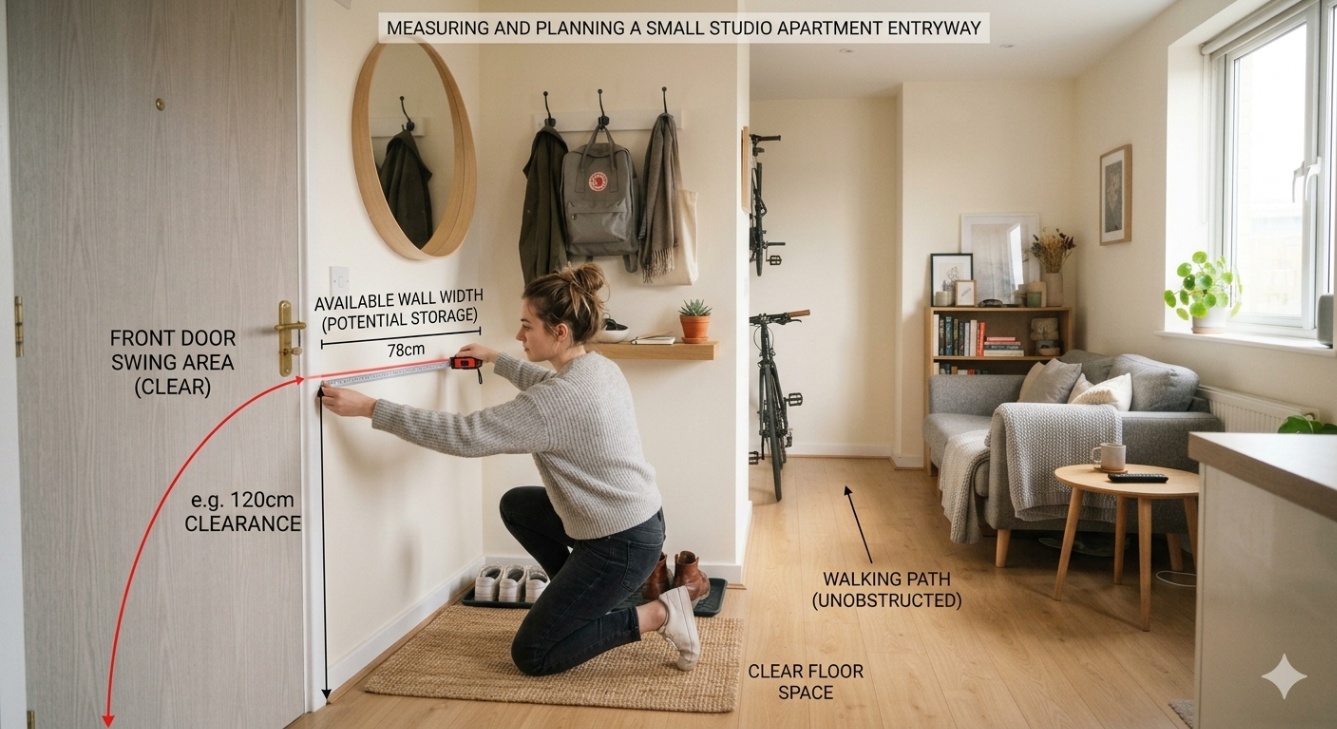
Measure Before You Add Storage
One of the easiest mistakes in a compact home is buying storage first and trying to make it fit afterward.
Instead, measure the area before choosing anything.
You do not need complicated architectural measurements.
Start with a few basic observations:
Available wall width
Available wall height
Available floor depth
Door swing area
Walking path
Existing closet dimensions
Distance between the entrance and nearby furniture
But remember that the most important measurement is not simply how much space exists.
It is how much usable space remains after people can comfortably move through the entrance.
A piece of furniture may technically fit against a wall but still make the entrance uncomfortable if it interferes with movement.
This matters particularly in a studio apartment because the entrance may also be part of the main circulation route.
Check The Door Swing Before Buying Anything
This is an overlooked issue in many entryway inspiration articles.
Imagine buying a beautiful shoe cabinet only to discover that the door hits it every time you open the apartment.
Before adding furniture, physically open the door several times.
Observe:
Where the door travels
Where the handle moves
Where people naturally stand when entering
Whether furniture would interfere
Whether drawers or cabinet doors could open comfortably
The best storage solution is useless if it blocks the entrance.
How to Create an Entryway When Your Studio Apartment Has No Foyer
Not every studio apartment has a separate entrance hall.
Sometimes the front door opens directly into the living area.
That does not mean you cannot create an entryway.
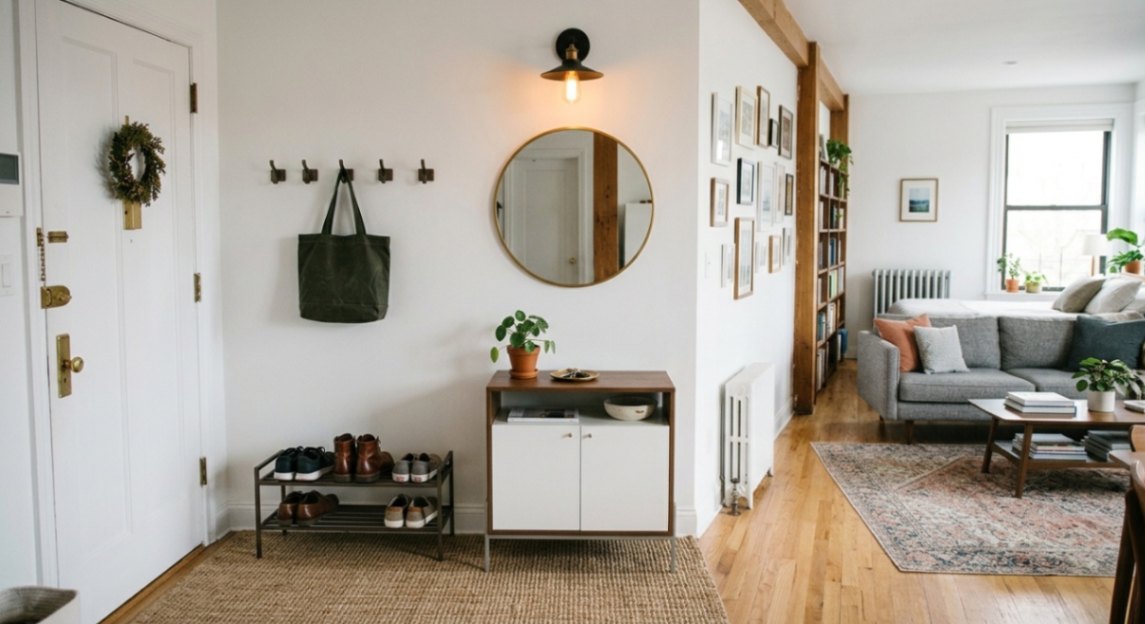
Instead, create an entry zone.
An entry zone is a visually and functionally defined area near the entrance that performs the jobs normally associated with a foyer.
You can create one using:
A small wall-mounted shelf
Hooks
A narrow shoe cabinet
A mirror
A small rug
A basket
A compact bench
A wall-mounted organizer
Lighting
A small decorative element
You do not need all of these.
Choose only what solves a real problem.
The concept of creating an entryway without a dedicated foyer is well established in small-home organization. Real-world small-apartment examples commonly use blank walls, vertical storage and visual cues to establish an entrance where the floor plan does not provide one.
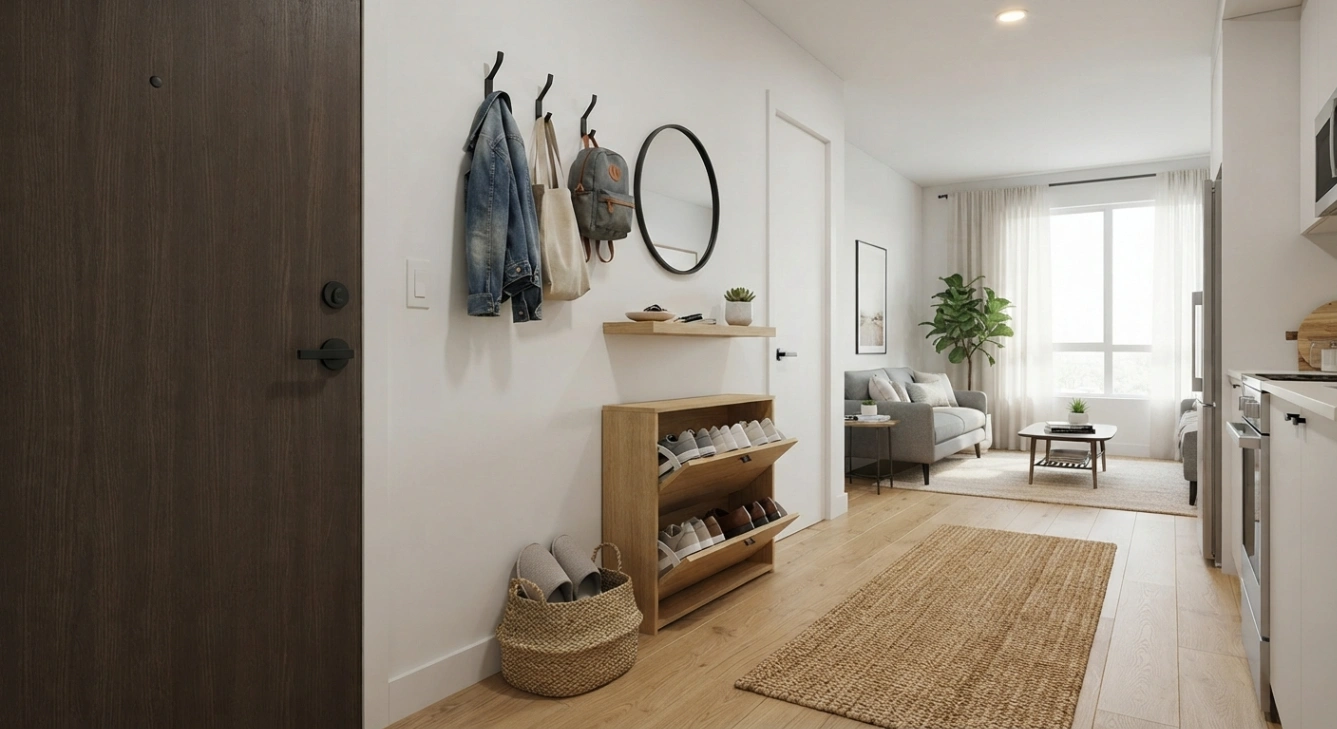
Try The One-Wall Entryway Approach
If you have one usable wall beside the entrance, make that wall responsible for several functions.
For example:
Upper area: hooks for bags and jackets
Middle area: mirror or small shelf
Lower area: shoe storage or basket
This approach uses vertical space instead of spreading storage across the floor.
If you want to study how different storage functions can work together visually, IKEA’s small hallway organization ideas provide useful examples of combining wall storage, shoe storage, hooks, trays, baskets and multifunctional furniture in compact entrances.
The important lesson is not to copy a particular IKEA arrangement.
Instead, study how several small functions can be combined without allowing storage to overwhelm the floor.
Build The Entryway Around What You Actually Use
A beautiful entrance can still be a poor entryway if it does not make daily life easier.
Start with the items that regularly enter and leave your home.
These might include:
- Keys
- Shoes
- Bags
- Jackets
- Work uniforms
- Umbrellas
- Sunglasses
- Wallet
- Everyday accessories
Now give the most frequently used items the easiest storage locations.
This creates what can be called a drop zone.
A drop zone is simply a designated place where you can put commonly carried items when you arrive home.
For example:
Keys → small tray or hook
Bag → wall hook
Shoes → lower cabinet or rack
Jacket → hook
Mail → small organizer
The simpler the system, the more likely you are to use it consistently.
Professional organizing guidance also emphasizes assigning specific homes to frequently used belongings rather than relying on one generic catch-all area.
The Entryway Drop-Zone Formula
Instead of thinking about the entrance as one storage area, divide it into small functions.
Zone 1 — Arrival
Where do shoes and bags land?
Zone 2 — Small Essentials
Where do keys, cards, sunglasses and other small items go?
Zone 3 — Outerwear
Where do jackets, hats or other frequently used items hang?
Zone 4 — Outgoing Items
Where do things that need to leave the apartment go?
This fourth zone is particularly useful.
For example, if you have something you need to take to work tomorrow, placing it near the door can prevent the classic “I forgot it at home” problem.
The entrance therefore becomes more than storage.
It becomes part of your daily routine.
The Main Components Of A Functional Small Entryway
A practical entryway does not need many items.
It needs the right functions.
Vertical Storage
Walls are often one of the most valuable resources in a small apartment.
Hooks, shelves, pegboards, wall organizers and tall cabinets can use vertical space without taking up much floor area.
This is particularly useful when your entrance is narrow.
Instead of asking:
“Where can I put another cabinet?”
ask:
“What can I move upward?”
That change in thinking can make a significant difference.
Shoe Storage
Shoes are one of the easiest things to allow to spread across a small entrance.
If shoes are left directly beside the door, they can quickly interfere with the walking path.
Consider:
- Slim Shoe Cabinets
- Vertical Shoe Storage
- Small Open Racks
- Under-Bench Storage
- A Designated Shoe Basket
- A Limited Everyday Shoe Area
The important principle is to avoid allowing the entrance to become general storage for every pair of shoes you own.
Keep frequently used footwear accessible and move less-used pairs elsewhere when possible.
A Place For Keys And Small Items
Small objects create surprisingly large amounts of visual clutter.
Keys, coins, sunglasses, cards and receipts can easily collect on whatever surface happens to be available.
A small tray, wall organizer, hook or narrow shelf can solve this problem.
The storage does not have to be large.
It simply needs to be predictable.
Coat And Bag Storage
Hooks can be extremely useful in compact entrances because they take advantage of wall space.
Instead of placing bags on a chair or leaving jackets on the bed, provide a specific location near the door.
But avoid filling every available wall with hooks.
Too many visible items can make the entrance feel crowded.
Use only enough storage for the things you realistically need there.
Mirror
A mirror can serve both a practical and visual function.
It gives you a convenient place to check yourself before leaving and can also help the entrance feel more finished.
In a small apartment, a wall-mounted mirror can provide this function without taking up floor space.
Seating
A seat can be useful if you regularly sit down to put on or remove shoes.
However, seating should be treated as optional.
If a bench makes the walking path too narrow, it may not be worth the space it occupies.
In very small entrances, a small stool or compact bench may work better than a full piece of furniture.
What If Your Apartment Has No Entry Closet
Many studio apartments do not have a proper entry closet.
This does not mean you cannot organize the entrance.
Instead of trying to recreate a traditional closet, distribute the functions.
For example:
• Shoes can stay in a slim cabinet near the entrance.
• Jackets can use wall hooks.
• Seasonal clothing can be stored in the main wardrobe.
• Bags can use hooks or a shelf.
• Small items can use a tray or organizer.
This creates a distributed storage system.
The entrance does not have to store everything.
It only needs to handle the items that are most useful there.
Entryway Ideas Without A Closet
If your apartment has no closet near the front door, consider:
- Wall-Mounted Hooks
- Floating Shelves
- Slim Shoe Storage
- Narrow Cabinets
- Baskets
- Pegboards
- Over-Door Organizers Where Appropriate
- A Small Wardrobe Positioned Elsewhere
- Storage Furniture That Performs More Than One Function
The key is to avoid forcing all your storage needs into the entrance itself.
Think Beyond The Front Door
This is one area where many entryway articles stop too early.
If the entrance cannot hold something comfortably, ask:
“Where else can this item live?”
For example, seasonal jackets may belong in the main wardrobe.
Extra shoes may belong under the bed.
Travel bags may belong in a high storage area.
The entryway should not be responsible for storing everything simply because it is closest to the door.
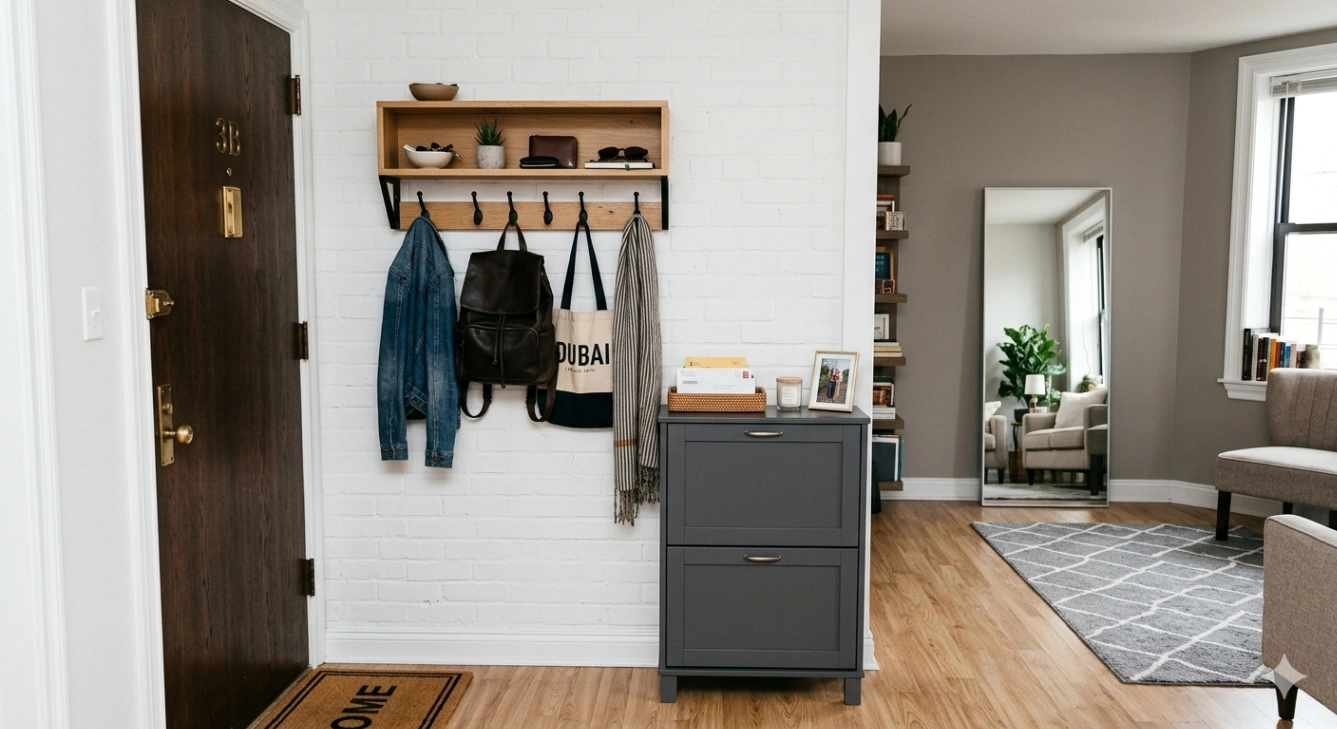
How To Organize A Small Entryway Closet
If your studio apartment already has a closet near the entrance, the problem changes.
Now the question becomes:
“How can you make the existing closet work better?”
Start by removing everything that does not belong there.
A closet near the entrance often becomes a convenient dumping ground.
Old bags, rarely used clothing, boxes, cleaning products and miscellaneous items can gradually take over.
Instead, divide the closet into categories.
Everyday Items
Place frequently used items in the easiest-to-reach locations.
These might include:
• Everyday Shoes
• Work Bag
• Jacket
• Frequently Used Accessories
Occasional Items
Less frequently used items can go higher or farther back.
These might include:
• Seasonal Accessories
• Special-Event Clothing
• Travel Bags
This creates a basic principle:
“The more frequently you use something, the easier it should be to reach.”
Use The Vertical Space Inside The Closet
Look upward.
Many small closets contain unused space above the items normally stored there.
Depending on the closet design, you may be able to use:
- Upper Shelves
- Stackable Storage
- Hanging Organizers
- Hooks
- Baskets
- Additional Shelving
But do not fill every centimetre simply because space exists.
Storage should make things easier to find, not simply allow you to own more things.
Rotate Your Closet By Season
If your climate and wardrobe require seasonal changes, do not force every season’s belongings into the easiest-to-reach section.
Keep the current season accessible.
Move less relevant items higher, farther back or to another storage location.
This keeps the closet focused on the things you are actually using.
Professional organizers also recommend seasonal rotation as a way of preventing high-traffic storage areas from becoming overloaded. For additional guidance, see A Fresh Space Organizing’s seasonal clothing swap guide.
Do Not Ignore The Closet Door
The inside of a closet door may provide additional organizational space.
Depending on the door and rental restrictions, you might use:
- Hooks
- Hanging Organizers
- Small Pockets
- Lightweight Accessories
Always make sure anything attached to the door does not interfere with the door closing properly.
The door should remain functional.
Group Similar Items Together
Organization becomes easier when similar things have a common location.
For example:
Shoes → Lower Section
Bags → Hooks Or Middle Section
Accessories → Small Organizer
Seasonal Items → Upper Section
This reduces the amount of searching required.
Instead of asking:
“Where did I put that?”
you begin to know:
“That type of item belongs there.”
That is what makes organization sustainable.
Open Closet Or Closed Closet: Which Works Better?
There is no universal answer.
The right choice depends on what you store and how often you use it.
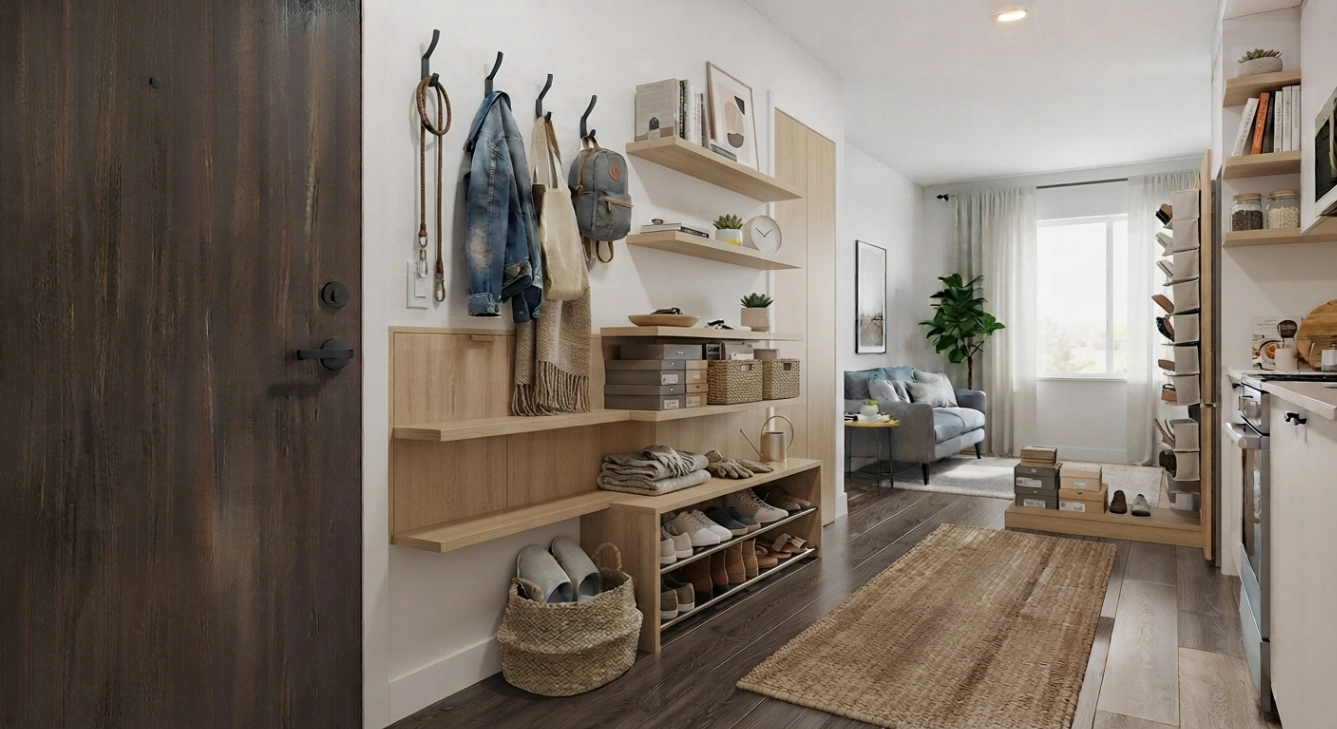
Open Storage
Open storage makes frequently used items easy to see and reach.
It can work well for:
- Everyday Shoes
- Bags
- Jackets
- Keys
- Accessories
The disadvantage is that everything remains visible.
If the area becomes cluttered, the entire entrance may look messy.
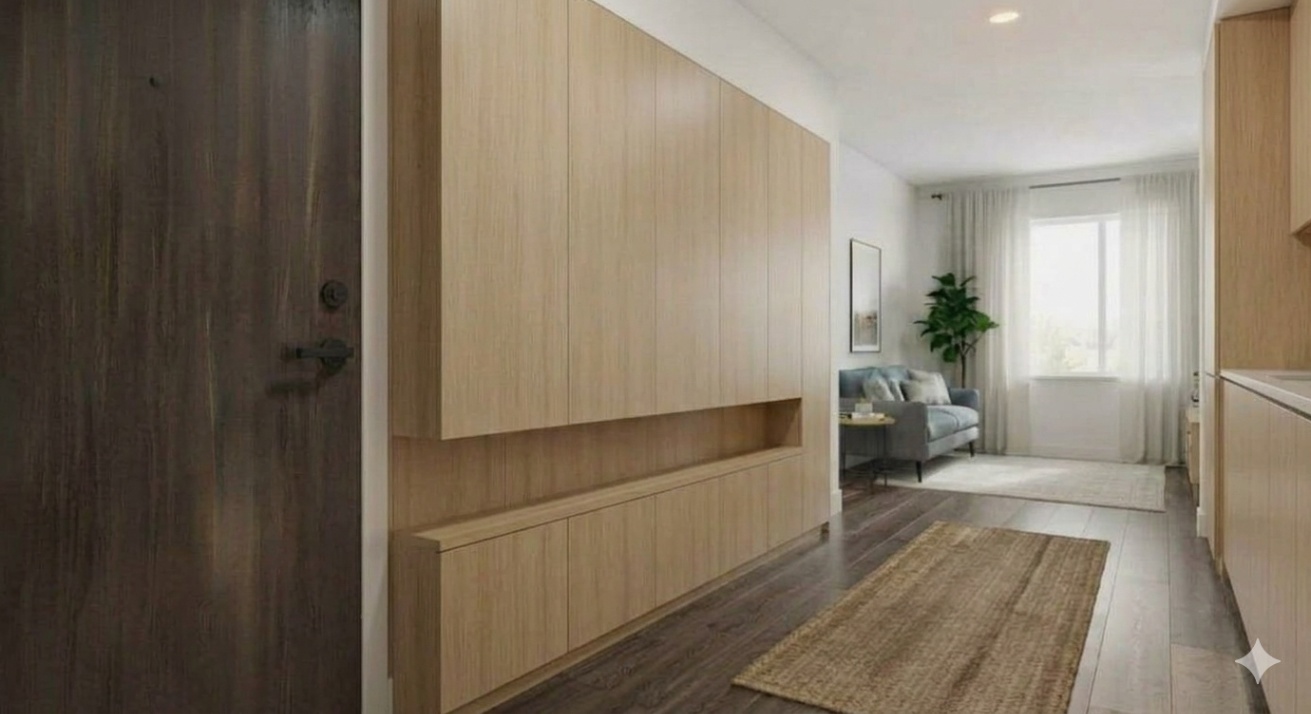
Closed Storage
Closed cabinets can visually hide clutter.
They can be useful for:
- Shoes
- Accessories
- Less Attractive Everyday Items
- Items You Do Not Want Visible
The disadvantage is that you may have to open doors or drawers every time you need something.
A Combination Can Work Well
You do not have to choose only one.
For example:
Open Hooks → Everyday Bags
Open Shelf → Keys
Closed Cabinet → Shoes
Upper Storage → Occasional Items
This creates a balance between accessibility and visual order.
Open Storage
Closed Storage
Studio Apartment Entryway Ideas For Different Space Problems
Not every studio apartment has the same entrance.
The best solution depends on what happens around your front door, how much wall space you have and how people move through the area.
Instead of looking for one perfect entryway design, identify the specific problem your entrance creates.
When The Door Opens Directly Into The Living Area
This is one of the most common challenges in a studio apartment.
When the front door opens directly into the living area, there may be no obvious place to create an entryway.
Instead of trying to create a separate room, create a small visual and functional boundary near the door.
You can use:
- A Small Rug
- A Narrow Shoe Cabinet
- A Wall-Mounted Shelf
- A Mirror
- A Small Basket
- A Few Hooks Where Appropriate
The goal is to make the entrance feel like a defined zone without blocking the main living area.
Keep the walking path open and avoid adding furniture simply because there is an empty wall.
The entryway should support movement into and out of the apartment, not create another obstacle.
When The Entryway Is Extremely Narrow
A narrow entrance requires more attention to depth than to the number of storage items you can fit.
A large cabinet may technically fit, but it could make the entrance uncomfortable.
In this situation, consider:
- Slim Shoe Storage
- Wall-Mounted Hooks
- Floating Shelves
- Narrow Mirrors
- Vertical Storage
- Wall-Mounted Organizers
The main principle is to keep the floor as open as possible.
If storage projects too far into the walking path, look for a shallower solution or move some belongings to another part of the apartment.
When The Entrance Is Beside The Kitchen
If the entrance is close to the kitchen, the area may already have a lot of visual activity.
Shoes, bags and kitchen items can easily begin competing for the same limited space.
Keep the entryway focused on entryway functions.
For example:
• Shoes → Entryway Storage
• Keys → Small Tray Or Wall Organizer
• Bags → Designated Hook Or Shelf
• Kitchen Supplies → Kitchen Storage
Avoid using the entrance as overflow storage for the kitchen.
If possible, use a narrow storage solution that clearly belongs to the entrance rather than allowing different categories of belongings to mix together.
When The Entrance Is Beside The Sleeping Area
In some studio apartments, the front door may be positioned relatively close to the sleeping area.
This can make the entrance feel less separate from the rest of the room.
The solution does not necessarily require a permanent divider.
You can create a subtle transition using:
- A Small Rug
- A Mirror
- A Narrow Storage Unit
- A Change In Lighting
- A Visual Boundary
- A Carefully Positioned Shelf
The goal is not to completely separate the sleeping area.
It is simply to give the entrance its own identity so that shoes, bags and outdoor belongings do not visually spill into the sleeping area.
When There Is No Closet And Almost No Floor Space
This is one of the most difficult entryway situations.
When there is no closet and almost no available floor area, the walls become especially important.
Look for ways to move storage upward.
You might use:
- Wall Hooks
- Floating Shelves
- Wall-Mounted Shoe Storage
- Small Baskets
- Pegboards
- Over-Door Storage Where Appropriate
But remember that vertical storage still needs to remain practical.
Do not place everyday items so high that they become difficult to reach.
The goal is to use unused wall space while keeping the most frequently used belongings convenient.
The most important lesson across all these situations is simple:
Do Not Design The Entryway You Wish You Had. Design The Entryway Your Apartment Can Actually Support.
The Current Rotation Idea for Shoes and Bags
One of the simplest ways to reduce entryway clutter is to stop treating the entrance as storage for your entire collection.
For shoes, keep only the pairs you use regularly near the door.
The same principle can apply to bags.
You may own several bags, but perhaps only one or two are used most days.
The entrance should support your current rotation, not your entire inventory.
This creates more space and makes the things you actually use easier to reach.
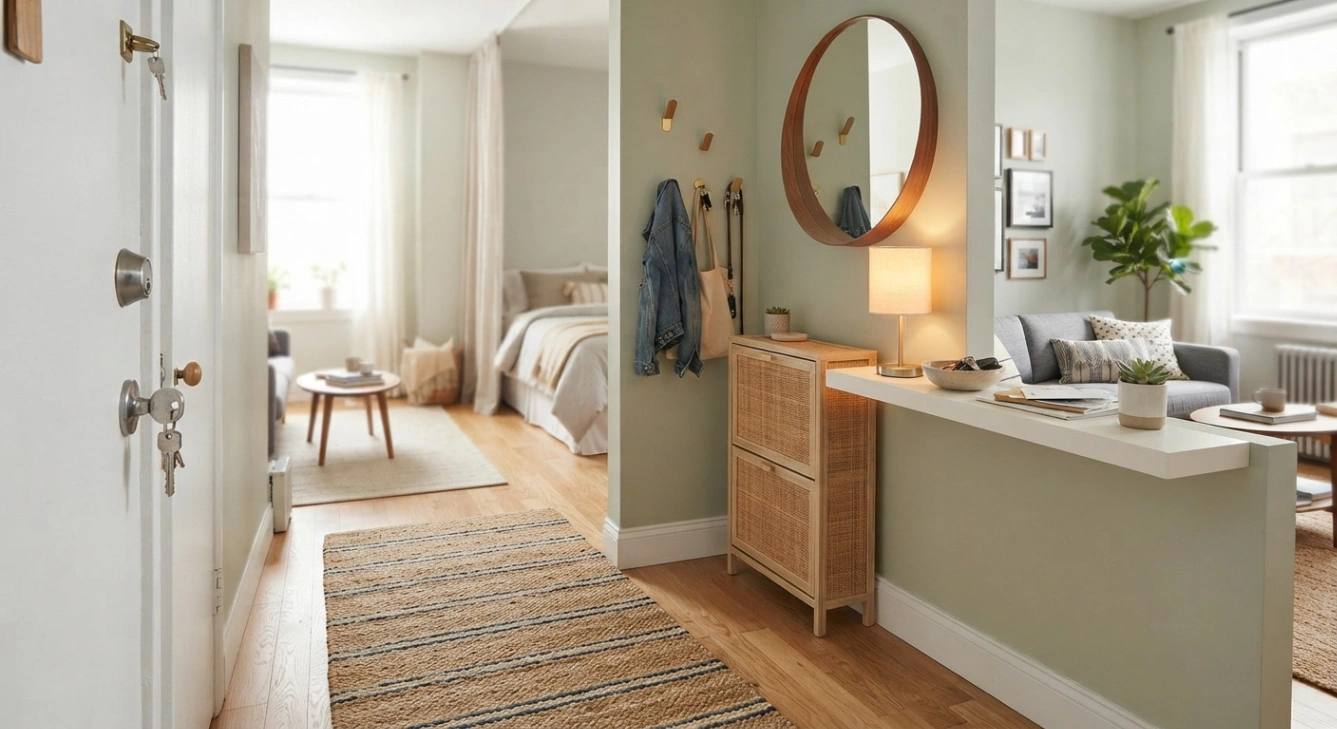
How to Make a Small Entryway Feel Separate From the Living Area
A studio apartment does not necessarily need walls to create separate functional zones.
You can use visual signals.
Use a Small Rug
A rug can visually mark the entrance area.
It tells the eye:
“This is the entrance zone.”
Make sure the rug does not create a tripping hazard or interfere with the door.
Use Lighting
Lighting can help distinguish the entrance from the rest of the apartment.
A small wall light or focused lighting can make the entrance feel more intentional.
Use a Mirror or Wall Art
A mirror or carefully selected piece of wall art can help establish the entrance as a defined area.
You do not need a large gallery wall.
One well-positioned item may be enough.
Use Storage as a Boundary
A narrow shelf or storage unit can create a subtle transition between the entrance and living area.
The storage does not have to act as a wall.
It simply gives the entrance a clear identity.
Use Color or Texture Carefully
You can also distinguish the entrance through a small change in:
- Rug texture
- Wall art
- Lighting
- Decorative color
- Storage finish
The purpose is not to create a completely different room.
It is simply to tell the eye where one functional zone begins.
For additional inspiration, Real Simple’s small-entryway ideas explores ways to make small entrances functional and welcoming through organization, appropriately scaled furniture, multifunctional pieces and carefully selected decorative details.
Renter-Friendly Entryway Solutions
Renting a studio apartment often comes with restrictions on permanent changes. You may not be allowed to drill holes, install built-in cabinets, modify doors, build new walls, or make electrical alterations.
Fortunately, you can still create a functional and organized entryway without making permanent changes to the property. The key is to choose flexible storage solutions that suit your available space and can be removed or relocated when necessary.
Depending on your rental agreement, consider the following options:
Removable Hooks: Use suitable removable hooks for everyday bags, lightweight jackets, hats, and keys. Always check the manufacturer’s weight limits and surface requirements.
Freestanding Shelves: Choose a compact shelving unit that provides storage without requiring permanent installation.
Lightweight Organizers: Use small organizers for keys, sunglasses, mail, and other everyday essentials to keep the entrance tidy.
Multifunctional Furniture: Consider a compact bench with storage or a narrow cabinet that serves more than one purpose.
Tension-Based Storage: Where appropriate, use tension-mounted organizers that fit securely between suitable surfaces without drilling.
Freestanding Mirrors: Add a standing or leaning mirror to make the entrance more practical without attaching anything to the wall.
Storage Baskets: Place a small basket near the entrance for frequently used accessories or other belongings that need a designated home.
Portable Shoe Storage: Use a lightweight shoe rack or compact shoe cabinet that can be moved easily if your layout changes.
Before installing or attaching anything, check your tenancy agreement and the property’s rules. Even removable products can damage certain painted surfaces, wallpaper, or finishes.
The goal is to improve your entryway while keeping your storage choices practical, reversible, and appropriate for your rental home.
Think Reversible First
Before choosing an entryway solution, ask yourself:
Can I remove or relocate this later without permanently changing the apartment?
This simple question helps you evaluate whether a storage idea is suitable for a rented space.
You can also test an arrangement temporarily before committing to it. For example, try placing a freestanding shoe rack beside the entrance or positioning a small basket near the door for a few days. Observe whether the arrangement improves your routine without obstructing movement.
A renter-friendly entryway does not need complicated installations or expensive furniture. With carefully chosen removable accessories, portable storage, and a layout that respects the available space, you can create an organized entrance while maintaining the flexibility to change it whenever necessary.
Common Entryway And Closet Mistakes
Understanding what does not work can be just as useful as studying successful examples.
Mistake 1: Buying Too Much Storage
More storage does not automatically mean better organization.
A large cabinet can make a small entrance feel even smaller.
Start with the problem.
Then choose the smallest solution that solves it.
Mistake 2: Ignoring The Walking Path
A storage unit may fit physically but still interfere with movement.
Always consider how you actually enter and leave the apartment.
Mistake 3: Storing Everything At The Entrance
Your entrance does not need to become a warehouse.
Keep the items you use there regularly.
Move seasonal and rarely used items to more appropriate storage elsewhere.
Mistake 4: Using Only Floor Storage
Floor space is precious in a studio.
Whenever possible, combine floor storage with vertical storage.
Mistake 5: Creating A System That Is Too Complicated
If you need several steps to put away your keys or shoes, you may stop using the system.
Good organization should make everyday life easier.
Mistake 6: Copying A Large-Home Entryway
An entryway that looks beautiful in a large house may not translate well into a studio apartment.
The scale is different.
The circulation is different.
The storage requirements are different.
Use inspiration as a starting point, then adapt the idea to your own space.
Mistake 7: Making Everything Visible
Open storage is useful, but too many visible objects can create visual noise.
If an entrance contains shoes, bags, jackets, mail, boxes and accessories all in plain sight, the space may feel cluttered even when everything technically has a place.
Use a mixture of open and closed storage where appropriate.
A Simple Entryway Planning Exercise
Before buying anything, take a few minutes to write down what actually happens at your entrance.
Step 1: List What You Bring Home
Write down the things you regularly carry.
For example:
Keys
Bag
Shoes
Jacket
Umbrella
Packages
Step 2: Identify Where Each Item Goes Now
Do not judge the current system.
Simply observe it.
Where do your keys go?
Where does your bag go?
Where do your shoes go?
Where does your jacket go?
Step 3: Identify The Problem
Maybe shoes block the entrance.
Maybe bags end up on the bed.
Maybe keys disappear.
Maybe jackets end up on a chair.
Step 4: Give Each Problem A Home
Now choose a simple solution.
Shoes → shoe storage
Keys → tray or hook
Bag → wall hook
Jacket → hook
Step 5: Test Before Committing
If possible, test the arrangement temporarily.
You may discover that something that looked good on paper is inconvenient in real life.
This is why observing your routine is so important.
Create A “One-Surface” Control Point
Small entrances often become messy because every flat surface becomes available storage.
A useful organizational experiment is to designate one small surface, such as a shelf or tray, as the controlled landing point for small belongings.
Keys, cards and other tiny items can have one predictable location rather than spreading across several surfaces.
Current organizing guidance also recommends using a deliberately controlled surface to reduce visual clutter, particularly in high-traffic areas such as entryways.
The important point is not to create another place where clutter can accumulate.
It is to create one intentional landing point.
Make The System Easy To Maintain
A storage system is only successful if you can keep using it.
This is why organization should include maintenance.
You do not need to spend an hour every day cleaning the entrance.
A simple routine may be enough.
Daily
Return keys, shoes and bags to their designated locations.
Weekly
Remove unwanted mail, packages and miscellaneous items.
Monthly
Review what is hanging or stored near the entrance.
Ask:
“Am I still using all of this?”
If not, move it elsewhere.
This keeps the entryway from slowly becoming overloaded.
A Practical Small-Entryway Checklist
Before considering your entrance complete, ask:
Space
Can I comfortably open the door?
Can I walk through without hitting furniture?
Have I protected the main walking path?
Can drawers and cabinet doors open properly?
Storage
Do everyday shoes have a place?
Do keys have a place?
Do bags have a place?
Do jackets have a place?
Is there somewhere for items that need to leave the home soon?
Closet
Have I removed items that do not belong?
Are everyday items easy to reach?
Is vertical space being used effectively?
Are less-used items stored higher or farther back?
Have I considered seasonal rotation?
Visual Order
Is the entrance visually calm?
Is there unnecessary furniture?
Is too much storage exposed?
Would a mirror or small decorative element help?
Does the entryway look connected to the rest of the studio?
Daily Use
Can I put things away quickly?
Can I find what I need easily?
Does the system match my actual routine?
Will I realistically maintain it?
If the answer is yes to most of these questions, your entryway is probably doing its job.
How The Entryway Connects To The Rest Of Your Studio
An entryway should not be treated as an isolated part of the apartment.
It connects directly to the rest of your home’s organization.
If the entrance is beside the kitchen, your storage decisions may affect the kitchen’s visual space.
If it is beside the sleeping area, entryway clutter can affect the bedroom.
If it is close to your workspace, bags and jackets can quickly become distractions.
This is why compact-home planning works best when you think in terms of connected zones.
For broader inspiration, visit our Studio Apartment Layout Ideas & Visual Styling Index, where different compact-home areas are organized into one central inspiration hub.
If your sleeping area is also part of the same open room, our guide to Studio Apartment Bedroom Ideas: Creating A Comfortable Sleeping & Rest Area explores ways to create a comfortable sleeping and rest area without making the space feel crowded.
If you work from home, our guide to Studio Apartment Home Office Ideas: Creating An Inspiring Workspace In A Small Room looks at how a workspace can be created within a small room while maintaining clear functional boundaries.
The same principle applies to the kitchen and bathroom.
You can explore our guides to Small Kitchen Layouts For Studio Apartments: Smart Micro Kitchen Ideas and Small Bathroom Layout Ideas For Studio Apartments: The Compact-Space Blueprint for additional compact-space planning ideas.
The objective is not to make every zone look identical.
It is to make the zones work together.
Entryway And Closet Inspirations: Choosing The Right Approach For Your Home
There is no single perfect studio apartment entryway.
A successful solution depends on:
The shape of your entrance
Your available wall space
Your walking path
Whether you have a closet
What you carry every day
How much storage you need
Whether you rent or own
How much visual clutter you are comfortable seeing
A person with a narrow entrance may need a very different system from someone with a larger wall beside the door.
Someone with an existing closet may need organization rather than additional furniture.
Someone without a closet may need a combination of wall hooks, shoe storage and distributed storage elsewhere.
This is why the best studio apartment entryway ideas are not necessarily the most elaborate.
They are the ones that solve the actual problem.
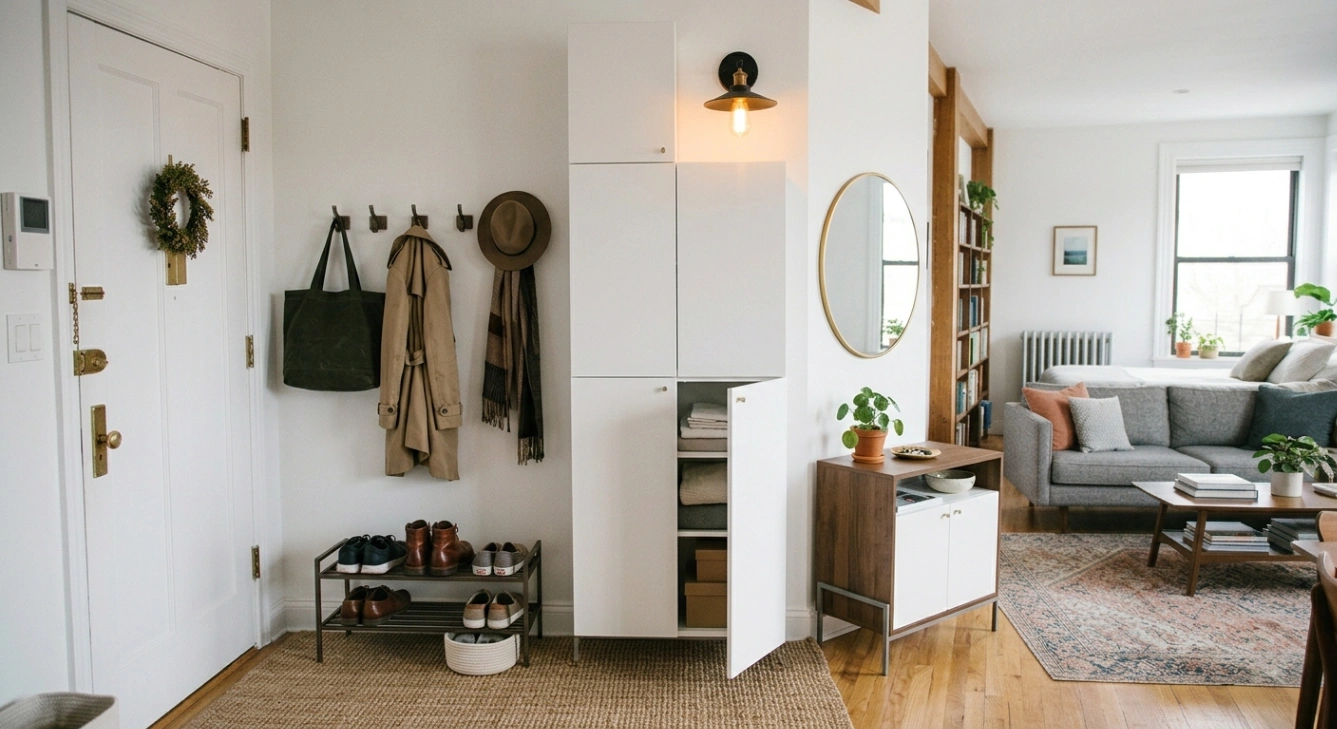
Frequently Asked Questions About Studio Apartment Entryway Ideas
How Do I Create An Entryway In A Studio Apartment?
Create a small functional zone near the front door using a combination of storage, hooks, a mirror, a rug, lighting or a small piece of furniture. You do not need a separate room or foyer.
What If My Studio Apartment Has No Entry Closet?
Use distributed storage. Keep everyday items near the entrance using hooks, shelves, shoe storage or baskets, while storing seasonal and less-used items elsewhere in the apartment.
How Do I Organize A Small Entryway Closet?
Start by removing items that do not belong. Group similar items together, keep frequently used items easy to reach and use vertical space for less frequently used belongings.
Is Open Or Closed Storage Better For A Small Entryway?
Both can work. Open storage provides easy access but keeps items visible. Closed storage hides visual clutter but requires an extra step to access items. A combination can provide a useful balance.
How Can I Save Floor Space In A Small Entryway?
Use vertical storage such as wall hooks, floating shelves, wall organizers and tall storage. Keep floor furniture narrow and make sure it does not interfere with the walking path.
How Can I Make My Small Entryway Look Less Cluttered?
Reduce the number of visible items, give everyday belongings designated homes, use closed storage where useful and avoid adding furniture that does not solve a specific problem.
What Are Good Renter-Friendly Entryway Ideas?
Depending on your rental agreement, consider removable hooks, freestanding furniture, baskets, lightweight organizers, portable shoe storage and freestanding mirrors.
Should I Keep All My Shoes In The Entryway?
Not necessarily. Keep the shoes you currently use most often near the entrance and move seasonal or rarely used footwear to another suitable storage area.
Does A Studio Apartment Really Need An Entryway?
Not necessarily a separate entryway room.
But having a defined entrance zone can make everyday organization easier, especially when the front door opens directly into the main living area.
Final Thoughts
A compact home does not necessarily need more space.
It needs each available space to have a clear purpose.
Your entryway may only occupy a small part of your studio apartment, but it has an important role.
It is where you transition between the outside world and your home.
It is where everyday items arrive.
It is where clutter can begin—or where organization can begin.
The best solution is not necessarily the biggest cabinet, the most expensive furniture or the most complicated storage system.
Start by observing your space.
Understand your walking path.
Check the door swing.
Identify what you actually use.
Measure before adding storage.
Use vertical space where appropriate.
Give everyday items predictable homes.
Keep less-used belongings somewhere else.
Rotate seasonal items when necessary.
Create a simple system that is easy to maintain.
And remember that an entryway does not need to be a separate room to function like one.
With the right approach, even a small area beside the front door can become a useful, organized part of your studio apartment.
The goal is simple: make entering and leaving your home easier, while allowing the rest of your compact space to remain comfortable and uncluttered.
These studio apartment entryway ideas can help you create a more organized entrance, even when space is limited and a separate foyer or closet is unavailable.
Written & Curated by Josiah Digital Hub
Discover more from Josiah Digital Hub
Subscribe to get the latest posts sent to your email.